
Why Does Asphalt Develop Potholes and What Happens Below the Surface?
Potholes usually show up at the surface, but the problem often starts deeper in the pavement. Once water gets through a crack, it begins weakening the layers below, and traffic keeps working that damaged area until the surface finally breaks apart.
October 1, 2026
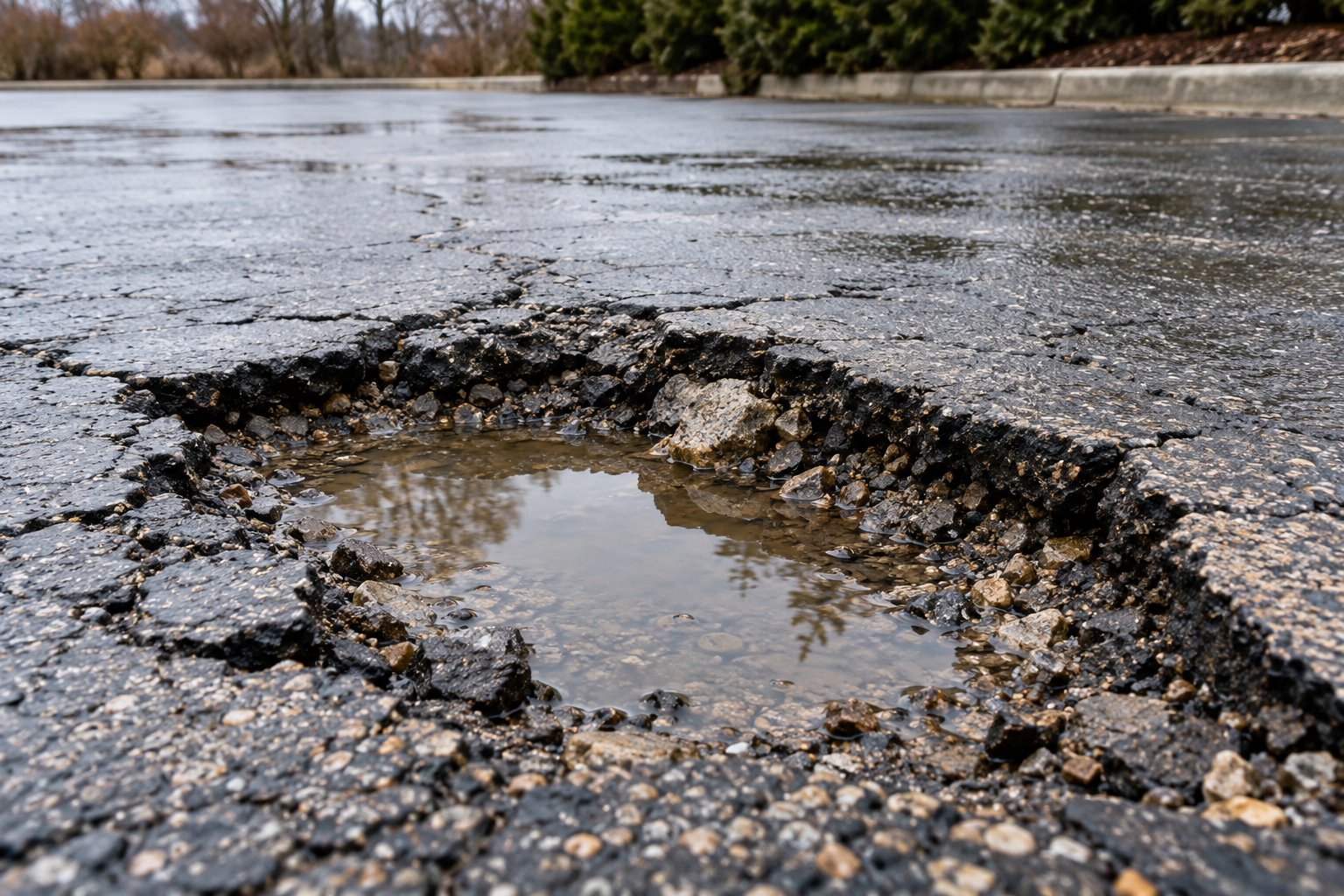
Potholes usually show up at the surface, but the problem often starts deeper in the pavement. Once water gets through a crack, it begins weakening the layers below, and traffic keeps working that damaged area until the surface finally breaks apart. Knowing what is happening underneath helps explain why some pothole repairs hold and others come back.
Where Do Asphalt Potholes Start?
Asphalt potholes begin with an opening in the surface course, usually a crack that gives water a path into the pavement structure. On parking lots and driveways, that top layer is often no more than a couple of inches thick. As the binder near the surface oxidizes and stiffens, it cracks under temperature swings instead of flexing with them, and rain and snowmelt run straight down through the opening.
That thin top layer seldom fails on its own. It stays intact until the material beneath it stops carrying its share of the load, which is why sealing cracks while they are still narrow keeps a pothole from forming in the first place.
What Happens When Water Reaches the Base?
Water that gets past the surface soaks into the aggregate base, the layer of compacted crushed stone that actually carries traffic loads. A dry, well-compacted base spreads the weight of each tire across a wide area of soil through tight contact between angular stones. Saturation loosens that contact, and the base starts to give under weight it once held firm.
Each passing vehicle then presses water and fine particles up and out through the crack, a process crews call pumping. Small voids open beneath the asphalt, and the unsupported surface bends with every load. That repeated bending splits the pavement into a web of interlocking cracks until tires pull the loose pieces free. The hole that finally appears is the last step of a failure that began several inches down.
How Do Freeze and Thaw Cycles Create Potholes?
Freeze and thaw cycles add a second force on top of that saturation, lifting the pavement and then leaving it without support. Water expands roughly 9 percent as it freezes, and fine-grained soils draw extra moisture upward into thin layers of ice beneath the base. Those ice layers raise sections of pavement unevenly through the coldest weeks.
Most of the damage comes once the thaw arrives. Pavement thaws from the top down, so meltwater collects in the upper soil and base while frozen ground below keeps it from draining. A lot or street is at its softest in that window, and a loaded truck crossing a saturated section pushes the surface down into the weak layer beneath it. A large share of the winter damage that surfaces each spring traces back to this stretch.
In Iowa, freeze cycles stack up between November and March, and every thaw reopens that soft window. Cold patch keeps a hole passable through those months, while a permanent repair waits for spring, when the base can dry out and be compacted properly.
Why Do Potholes Return to the Same Spot?
Potholes that return to the same spot after patching usually trace back one layer deeper, to the subgrade soil beneath the aggregate base. Clay-rich soils hold water far longer than sandy or gravelly ones and lose much of their bearing capacity while wet. A patch placed over that soft ground sits on the same weak footing as the asphalt it replaced.
Drainage decides how often that soil stays wet. Water that stands in low spots or collects along curb lines after a rain keeps moisture in contact with cracks and pavement edges, feeding the same soft area again. Correcting the grade so runoff moves off the surface and away from the base deals with the cause instead of the symptom.
How Should Asphalt Potholes Be Repaired?
Asphalt potholes should be repaired down to the layer that failed, whether that turns out to be the base or the soil beneath it. The cold patch that keeps a hole passable through winter is a stopgap, since it rests on the same wet, weakened base that caused the hole.
A full-depth patch follows a different sequence. Crews saw-cut the damaged area into a square or rectangle that extends about a foot past the visible cracking into sound pavement. The broken asphalt and any saturated base come out, the base is replaced or recompacted, and a tack coat goes on the vertical edges so the new hot mix bonds to the old. Hot mix then goes in and gets compacted in lifts until the patch sits level with the surrounding surface.
Filling the opening at the surface only addresses what a pothole leaves behind. A repair that holds starts by finding how far the failure extends, removing material that can no longer support traffic, and rebuilding the pavement from a firm base upward. Crack sealing and proper drainage can then limit the water movement that started the problem in the first place.
Des Moines Asphalt and Paving handles that work from the surface down, with crack sealing, patching, milling, and grading available to address both the damaged asphalt and the conditions beneath it. Request a quote to plan a pothole repair around what is actually happening below the pavement.